


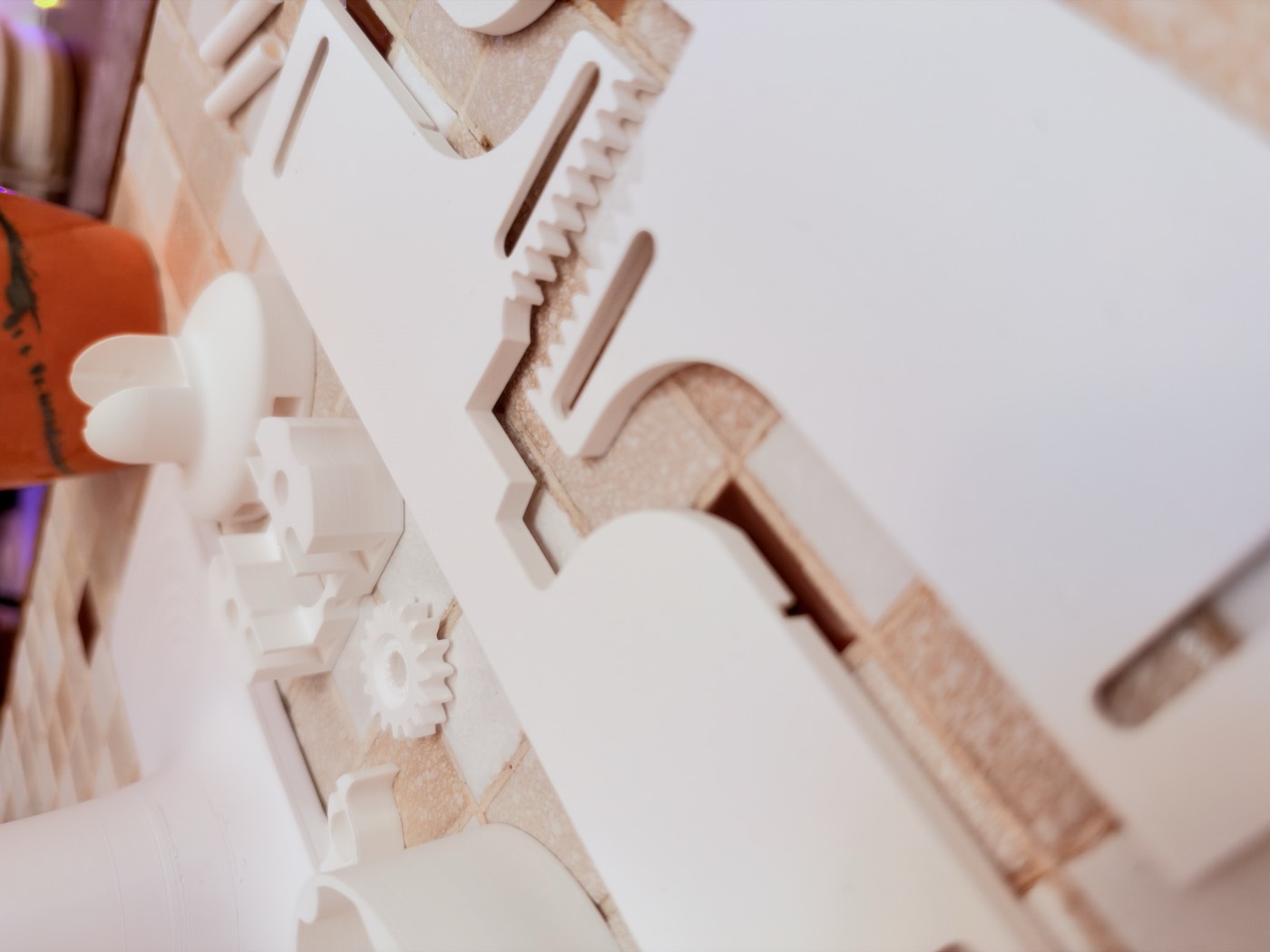

Push-to-Grip Mechanism A push-driven clamp for the mop head
A 16 mm push closes the clamp through 30 mm of jaw travel. A helical cam turns a 16-tooth involute pinion, the pinion drives two opposed racks, and a ratchet holds the grip. The 16 parts are Grasshopper C# components that share one base plane, so the stack builds coaxial and every number in the spec is checked against the others.
- Jaw travel
- 30mm
- Grip
- 79N
- Push stroke
- 16mm
- Height
- 44mm
- The push sets the budget. Rack force × travel = push force × stroke, 2400 N·mm either way, so doubling the travel from 15 to 30 mm halved the grip from 158 to 79 N. No cam geometry avoids that; a two-stage cam spends it unevenly instead, with 158 N over the last 6 mm.
- The wrap-spring clutch failed on the bench. Its steel coils cut a thread into the printed shaft and turned freely both ways: line contact puts PLA, PETG and POM at 2–3× their yield. The build moved to a ratchet and pawl, which loads a tooth flank in compression.
- Sized for the worst case. 169 N at the pawl gives 22.4 MPa of face pressure and 33.2 MPa of web bending, against about 65 MPa for POM.


